Vencatesen Ponin, Sustainability and Climate Change Programme, Université des Mascareignes
Sanju Deenapanray, Ecological Living in Action Ltd.
Vedika Hurdoyal, Mahatma Gandhi Institute, Moka
Jaya Gajparia, University of Exeter
Introduction
The pervasiveness and scale of the environmental crisis is increasingly perceived as a direct consequence of the state of alienation of human beings from nature, rooted in a techno-economic system that runs on capital accumulation and technology development (Choquet, 2020; Ruuska, 2021). Studies have shown that religion could offer a promising path to address this disconnect (Sponsel, 2012; Hitzhusen and Tucker, 2013).
Building on Lynn White's 1967 seminal critique of Judeo-Christian values, the field of religious environmentalism has progressively expanded from hermeneutical and theological dimensions to include social-scientific dimensions (Hayes & Marangudakis 2001; Sherkat & Elison 2007; Veldman et al. 2013). However, comparatively less emphasis has been laid on how these theological messages are psychologically perceived, processed and enacted at the individual cognitive level.
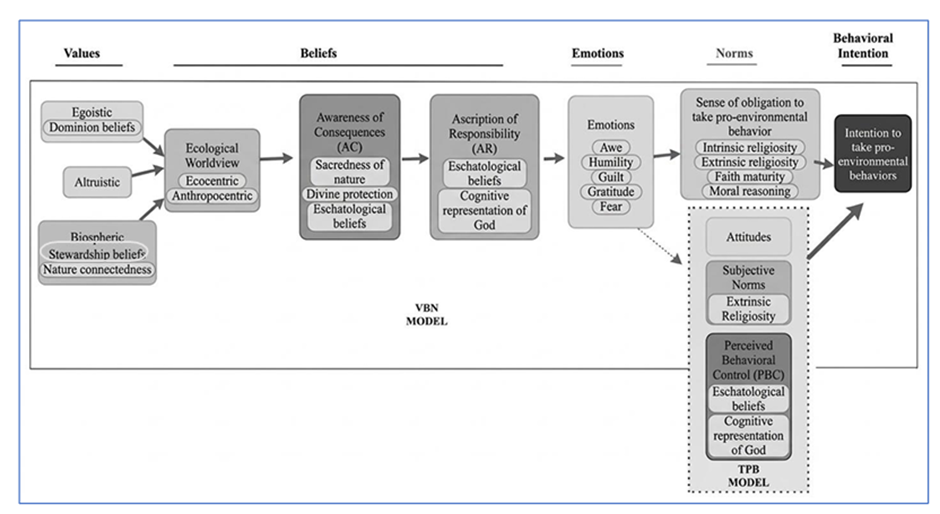
This study seeks to bridge this gap by grounding religious environmentalism into established psychological frameworks of environmental behaviour. Combining two core psychological theories of environmentalism, namely the Value-Belief-Norm (VBN) theory (Stern et al., 1999) and the Theory of Planned Behaviour (TPB) (Steg and Nordlung, 2018; Ajzen, 1991), it attempts to explain the cognitive processes that underlie religious environmentalism. Based on the integrated VBN-TPB Model, the authors formulated an integrative conceptual framework that visually captures how the various religious determinants interface with components of the model.
The Psychological Basis of Environmentalism
Studies in environmental psychology have shown that several internal and external factors are at play in motivating pro-environmental behaviour (Bamberg and Möser, 2007; Gifford and Nilsson, 2014). These include:
- Attitudinal factors such as values, beliefs, attitudes, norms;
- Socio-demographic factors such as habits,
- Individual factors: environmental knowledge, time, degree of perceived control, emotions; and
Social and economic factors such as income and class.
The Value-Belief-Norm (VBN) theory of environmentalism suggests that pro-environmental behaviour is shaped by a person’s values, their beliefs about environmental problems, and the extent to which they feel a personal moral obligation to act. The theory identifies three broad value orientations—egoistic, social-altruistic, and biospheric—that can influence environmental behaviour.
Like the VBN, the theory of planned behavior (TPB) has been widely used for studying individual environmental behaviors. The TPB suggests that people are more likely to engage in a behaviour when they intend to do it. This intention is shaped by how they feel about the behaviour (attitude), whether people important to them support or expect it (subjective norm), and whether they believe they are capable of doing it (perceived behavioral control (Ajzen, 1991).
While each framework offers valuable insights with- VBN emphasizing the role of personal values, ecological worldviews, and moral obligations, and TPB focusing on attitudes, subjective norms, and perceived behavioral control-their combined application allows for a more comprehensive understanding of the determinants underlying pro-environmental actions.
The Intersection of Religion with Environmental Psychology
In religious contexts, stewardship beliefs may encourage an ecocentric worldview, whereas dominion beliefs may promote a more anthropocentric view. Stewardship beliefs encompass fundamental narratives of care for creation and emphasize the sanctity of life and the ethical obligations humans have toward the natural world. In Christianity, this is exemplified by God’s ownership of the world and his command for humans to take care of it. This is echoed in many Bible verses, such as “The earth is the Lord’s, and everything in it, the world, and all who live in it (Psalm 24:1)”. On the other hand, dominion beliefs represent a theological perspective that aligns with an egoistic value orientation and explicitly advocates human dominance over nature, as a divine right (White, 1967). The dominion perspective justifies human superiority over nature and exploitation of it for humans’ benefits.
By cognitively framing environmental features as infused with spiritual values, sacred beliefs may influence awareness of consequences (AC) and amplify a person’s recognition that environmental conditions are threatened. Individuals who perceive nature as sacred often exhibit enhanced sensitivity to environmental issues and greater connectedness to nature (Tarakeswar et al. 2001).
Eschatological beliefs, an important component of many religious cosmologies, pertain to concepts of the end times or final events in the history of humanity. These beliefs have been associated with reduced risk perception (AC), ascription of responsibility for environmental change (AR), and perceived behavioral control (PBC) (Carr et al. 2012; Sachdeva 2017, Nche 2020). However, eschatological beliefs are complex and varies by context and individual interpretation. Such beliefs may also foster a perceived sense of higher environmental risk, depending on how individuals interpret their religious traditions.
Religious and spiritual experiences are rich in both positive and negative emotions (Emmons 2005). Emotions such as awe, guilt, gratitude, fear and hope are deeply embedded in religious experience and serve as affective triggers for norms activation (Piff et al. 2015; Brosch & Steg 2021; White & Billet 2024). However, different emotions tend to have different appraisal patterns,and thus lead to specific motivational tendencies for environmental actions.
By mapping several aspects of religiosity for their psychological influence on the components of the VBN-TPB chain, the authors have developed an integrative framework that visually captures this interface. The integrative framework is illustrated below.
Implications for Faith-Based Environmental Engagement
This conceptual framework embeds theological concepts within a systemic framework, thereby offering a structured and coherent basis for examining the cognitive determinants and effect pathways underlying religious environmentalism. It yields several important insights that have significant implications. For instance, the framework posits that environmental engagement within religious contexts is not simply a result of a linear outcome from stewardship beliefs to environmental actions as is often assumed. The model asserts that values, ecological worldviews, awareness of consequences, ascription of responsibility and emotions must converge to induce a sense of personal moral obligation to care for the environment. Beliefs or values alone are insufficient. Therefore, it is crucial to consider individuals’ religious schema of human-nature interactions, value orientations, sacred perceptions of environmental risk, type of eschatological beliefs, cognitive representations of God, and the emotional states elicited.
- Read the full article here: Ponin, Vencatesen, Prakash N. K. Deenapanray, Vedika Hurdoyal, and Jaya Gajparia. 2026. “ From Religious Beliefs to Environmental Engagement: Using an Integrative VBN-TPB Model to Inform a Conceptual Framework of Religious Environmentalism,” Religion Compass: e70062. https://doi.org/10.1111/rec3.70062.
References:
Ajzen, I. 1991. The theory of planned behavior. Organizational Behavior and Human Decision Process 50.2: 179–211.
Bamberg, S., and G. Möser, G. 2007. Twenty years after Hines, Hungerford, and Tomera: A new meta-analysis of psycho-social determinants of pro-environmental behaviour. Journal of Environmental Psychology 27.1: 14-25.
Choquet, P.L. 2020. Alienation and the task of geo-social critique. European Journal of Social Theory 24.1: 105-122. 10.1177/1368431020926113.
Elizabeth J. Krumrei-Mancuso, Janet P. Trammell, Jennifer A. Harriger, Joshua A. Evans. 2025. Replicating and extending research on sanctification: A cognitive appraisal with implications for behaviors, attitudes, and self-image. International Journal of Clinical and Health Psychology, 25.2: 100566.
Hitzhusen, G.E. and M.E. Tucker, M.E. 2013. The potential of religion for Earth Stewardship. Frontiers in Ecology and the Environment 11: 368-376. https://doi.org/10.1890/120322
Ruuska, T. 2021. ‘Conditions for Alienation: Technological Development and Capital Accumulation', in Pasi Heikkurinen, and Toni Ruuska (eds), Sustainability Beyond Technology: Philosophy, Critique, and Implications for Human Organization. Oxford Academic.
Sherkat, D. E. and C.G. Ellison. 2007. Structuring the religion-environment connection: Identifying religious influences on environmental concern and activism. Journal for the Scientific Study of Religion 46: 71–85.
Sponsel, L. E. 2012. Spiritual ecology: A quiet revolution. Praeger.
Steg, L. and A. Nordlund. 2018. Theories to explain environmental behaviour in L. Steg, & J. I. M. de Groot (Eds.), Environmental Psychology: An Introduction (pp. 217-227). Wiley. https://doi.org/10.1002/9781119241072.ch2
Stern, P. C., T. Dietz, T. Abel, G.A. Guagnano and L. Kalof. 1999. A value–belief– norm theory of support for social movements: The case of environmentalism. Human Ecology Review 6: 81–97.
Tarakeshwar, N., A.B. Swank, K.I. Pargament and A. Mahoney. 2001. The Sanctification of Nature and Theological Conservatism: A Study of Opposing Religious Correlates of Environmentalism. Review of Religious Research 42.4: 387–404. https://doi.org/10.2307/3512131
Veldman RG. 2019. The gospel of climate skepticism: why evangelical Christians oppose action on climate change’. University of California Press.
White, C.J and M.I. Billet. 2024. The roles of anthropomorphism, spirituality, and gratitude in pro-environmental attitudes. Religion, Brain and Behavior, 1–19. https://doi.org/10.1080/2153599x.2024.2363759
White, L. 1967. The historical roots of our ecologic crisis. Science, 155. 3767: 1203 1207.
Main photo: A climate change march with interfaith participants in Vatican City in 2015. © Mat McDermott / GreenFaith / CC BY-NC-ND
Charles Telfair Centre is an independent nonpartisan not for profit organisation and does not take specific positions. All views, positions, and conclusions expressed in our publications are solely those of the author(s).